> ## Documentation Index
> Fetch the complete documentation index at: https://docs.costory.io/llms.txt
> Use this file to discover all available pages before exploring further.
# Contracted Cost vs Billed Cost: Savings Plan discount sharing issues
> Learn why Contracted Cost gives platform and engineering teams a stable, usage-driven view of AWS and GCP cloud spending, avoiding misleading Savings Plan cost fluctuations.
# Contracted Cost vs Billed Cost: Stable Cloud Cost Metrics
## Why Billed Cost Is Misleading When Using AWS Savings Plans
If you're a **platform engineer**, **SRE**, or **engineering manager** responsible for cloud costs, you've probably seen cost dashboards that don't match reality. The root cause is often how your cloud provider allocates Savings Plan discounts, not anything your team actually changed.
When you purchase a Savings Plan (AWS) or Committed Use Discount (GCP) that covers multiple accounts or projects, the cloud provider can reassign which resources benefit from the discount over time. This means the **Billed Cost** for a given account, cluster, or service can fluctuate significantly, even when actual usage hasn't changed at all.
This is a well-documented challenge in cloud cost management. AWS itself acknowledged it by launching [RI & Savings Plans Group Sharing](https://aws.amazon.com/blogs/aws-cloud-financial-management/control-your-aws-commitments-with-risp-group-sharing/) to give organizations more control over discount allocation. Google Cloud offers [CUD attribution modes](https://cloud.google.com/docs/cuds-attribution) (proportional and prioritized) to mitigate unpredictable cost fluctuations across projects. The [FinOps Foundation](https://www.finops.org/wg/commitment-based-discounts-overview/) also highlights this as a core challenge: commitment discounts often apply across an organization's hierarchy in ways that don't align with actual resource consumption. AWS even published a dedicated guide on [building a Savings Plan chargeback strategy](https://aws.amazon.com/blogs/aws-cloud-financial-management/aws-savings-plans-how-to-implement-an-effective-chargeback-strategy/) to redistribute costs after the fact.
Costory fixes this problem with a simple approach: **Contracted Cost** strips discounts out entirely so you see only what your usage would cost under your negotiated rates, with no redistribution logic and no assumptions about Savings Plan discount allocation. For a full comparison of all cost metrics, see [Cost Metrics](/docs/cost-metrics).
### Example: Savings Plan moves between Kubernetes clusters
Imagine you have two EKS clusters and a global Savings Plan:
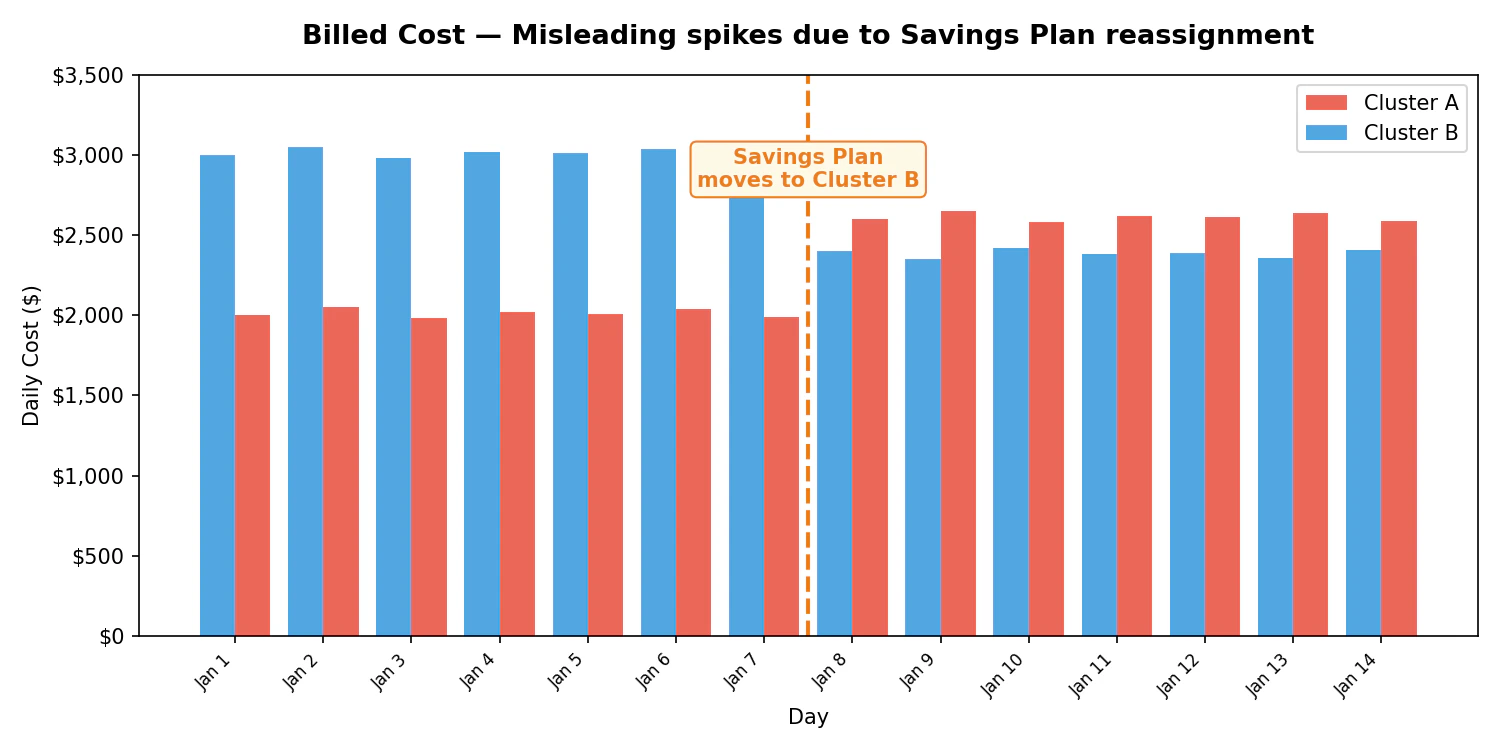
| | Cluster A | Cluster B |
| ---------------------------- | --------------------------------- | -------------------------------------- |
| **Before SP move** (Jan 1–7) | SP applied → **\$2,000/day** | No SP → **\$3,000/day** |
| **After SP move** (Jan 8–14) | No SP → **\$2,600/day** (+30% 🔴) | SP applied → **\$2,400/day** (-20% 🟢) |
If you track **Billed Cost**, Cluster A appears to spike +30% overnight. Your platform team opens an incident, engineers start investigating, but there's nothing to find. The actual usage hasn't changed, only which cluster receives the SP discount. This is wasted engineering time caused by unreliable cost data.
 ## What Is Contracted Cost and How It Solves This
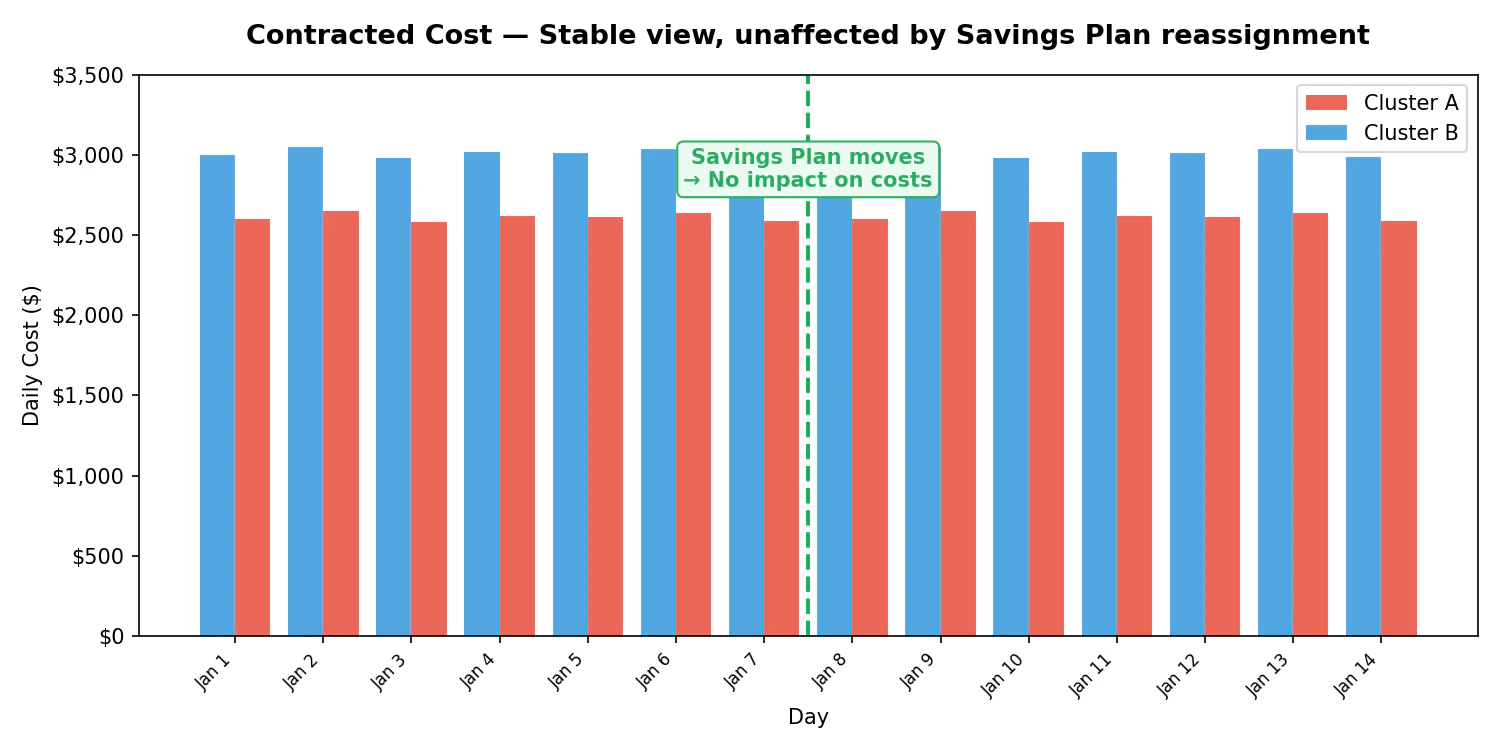
**Contracted Cost** is a cloud cost management metric that strips out all Savings Plan discounts and credits, but keeps your negotiated EDP pricing. This gives you a stable view of costs that only changes when actual usage changes, making it ideal for AWS cost optimization workflows.
## What Is Contracted Cost and How It Solves This
**Contracted Cost** is a cloud cost management metric that strips out all Savings Plan discounts and credits, but keeps your negotiated EDP pricing. This gives you a stable view of costs that only changes when actual usage changes, making it ideal for AWS cost optimization workflows.
 ### GCP clarification: CUD movement has the same reporting risk
This feature is currently available for **AWS** only. While GCP has the same challenge with Committed Use Discounts moving across projects, Contracted Cost support for GCP is not yet available.
* On GCP, Committed Use Discounts (CUDs) can move between projects over time, so **Billed Cost** per project can fluctuate even when usage is unchanged.
* CUD attribution modes (proportional vs. prioritized) affect how discounts are assigned and can make cost trends harder to interpret for engineering teams.
* Contracted Cost would provide the same stable, usage-driven view for GCP once supported.
Use **Contracted Cost** as the default metric in any cost dashboard shared with engineering teams (e.g., team leads reviewing Kubernetes spend or SREs investigating cost anomalies).
It ensures cost variations reflect real usage changes, not Savings Plan movements.
## How to Monitor Savings Plan Utilization Alongside Contracted Cost
Since Contracted Cost removes the [Savings Plan](https://docs.aws.amazon.com/savingsplans/latest/userguide/what-is-savings-plans.html) from the picture, you should separately monitor your Savings Plan utilization to catch:
* **Under-usage**: You're paying for a Savings Plan but not using enough eligible resources → wasted commitment.
* **Over-usage**: Your eligible usage exceeds your Savings Plan coverage → you're paying on-demand rates for the excess.
Planning per-team cloud budgets? Contracted Cost is the recommended metric for team-level budgeting because it removes Savings Plan noise. See our step-by-step guide: [Automate your cloud budget](/use-cases/automate_budget).
### GCP clarification: CUD movement has the same reporting risk
This feature is currently available for **AWS** only. While GCP has the same challenge with Committed Use Discounts moving across projects, Contracted Cost support for GCP is not yet available.
* On GCP, Committed Use Discounts (CUDs) can move between projects over time, so **Billed Cost** per project can fluctuate even when usage is unchanged.
* CUD attribution modes (proportional vs. prioritized) affect how discounts are assigned and can make cost trends harder to interpret for engineering teams.
* Contracted Cost would provide the same stable, usage-driven view for GCP once supported.
Use **Contracted Cost** as the default metric in any cost dashboard shared with engineering teams (e.g., team leads reviewing Kubernetes spend or SREs investigating cost anomalies).
It ensures cost variations reflect real usage changes, not Savings Plan movements.
## How to Monitor Savings Plan Utilization Alongside Contracted Cost
Since Contracted Cost removes the [Savings Plan](https://docs.aws.amazon.com/savingsplans/latest/userguide/what-is-savings-plans.html) from the picture, you should separately monitor your Savings Plan utilization to catch:
* **Under-usage**: You're paying for a Savings Plan but not using enough eligible resources → wasted commitment.
* **Over-usage**: Your eligible usage exceeds your Savings Plan coverage → you're paying on-demand rates for the excess.
Planning per-team cloud budgets? Contracted Cost is the recommended metric for team-level budgeting because it removes Savings Plan noise. See our step-by-step guide: [Automate your cloud budget](/use-cases/automate_budget).